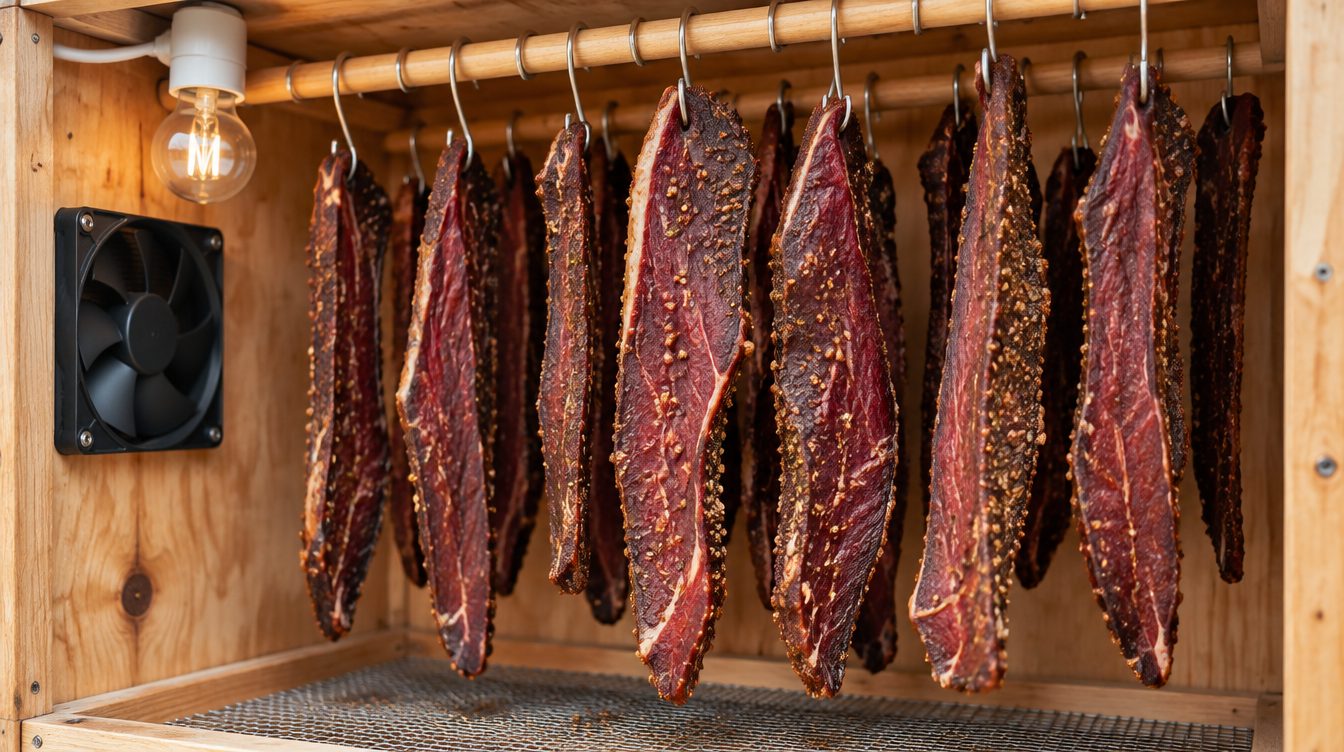
Quick answer
Biltong that will not dry is usually caused by high humidity, poor airflow, or pieces that are cut too thick or hung too close together. Keep the humidity below about 60 percent, use a fan that pulls damp air out of the box rather than blasting the meat, cut strips about 1/2 inch (10 to 15 mm) thick, and leave space between them.
Biltong is simple in theory: cure the beef in salt, vinegar and spices, hang it, and wait. In practice it can sit in the box for a week and still feel soft and wet in the middle, or worse, grow mold. If your biltong is not drying, the problem is almost always the drying conditions rather than the recipe.
How biltong is supposed to dry
Unlike jerky, biltong is not cooked or dried with heat. It is air dried slowly in whole strips. Moisture moves from the center of the meat to the surface, then evaporates into the surrounding air, which needs to be carried away. If any part of that chain stalls, the biltong stalls. If you are not sure how it differs from jerky, our guide on biltong vs beef jerky explains.
7 reasons your biltong is not drying
1. The air is too humid
If the air around the meat is already damp, it cannot take on more moisture. Coastal homes, rainy climates, basements and kitchens are all challenging. Try to keep the humidity below about 60 percent. A cheap hygrometer in the box tells you where you stand.
2. There is not enough airflow
Still air sits around the meat and stays damp. A small computer fan is enough, but it should pull humid air out of the box rather than push air in, so fresh, drier air is drawn past the meat.
3. The airflow is too strong
The opposite problem. A strong fan blowing straight onto the meat dries the surface too fast and forms a hard shell. This is called case hardening. It traps moisture inside, so the outside feels done while the middle stays raw and wet.
4. The pieces are too thick
Thick strips take far longer and are prone to case hardening. Cut the meat about 1/2 inch (10 to 15 mm) thick, along the grain.
5. The pieces are touching
Where strips touch each other or the side of the box, air cannot reach. Those spots stay wet and are where mold usually starts. Leave a finger width gap between pieces.
6. The room is too cold
Cold air holds less moisture and drying slows down a lot. Many people use a low wattage incandescent bulb in the box for gentle warmth. Keep it well away from the meat. You want warm air, not cooked biltong.
7. It was soaked in vinegar too long
A long vinegar soak can make the surface rubbery, which slows drying. A brief dip or a light coating of vinegar is enough.
How to fix biltong that is not drying
- Check the humidity. If it is high, move the box somewhere drier, such as a heated room, or run a dehumidifier nearby.
- Set the fan to extract air from the box, with vents low down so fresh air is drawn in.
- Space the strips out so none are touching.
- If the room is cold, add gentle warmth from a low wattage bulb positioned well away from the meat.
- If the outside is hard but the inside is wet, slow things down: reduce the fan speed so the moisture inside has time to move out.
- Be patient. Depending on thickness, humidity and how dry you like it, a batch often takes somewhere between four and ten days.
How to tell when biltong is done
Biltong is done when it reaches the texture you like. Wet biltong is soft and red in the middle. Medium is firm on the outside with a slightly soft center. Dry is firm all the way through. Many makers weigh a strip at the start and aim for it to lose around half its weight for medium biltong. Squeeze the thickest part of a strip. If it is still squishy or cold and damp, it needs more time.
Is it mold or salt?
- White, dry, powdery spots that wipe off are usually salt or fat coming to the surface. These are harmless.
- Fuzzy white, green, blue or black growth is mold. Throw that batch away. Do not just wipe it off, because mold can grow deeper than you can see.
Biltong is a raw, cured product, so good hygiene matters. Use fresh, good quality beef, clean equipment and a clean box. People who are pregnant, elderly or have weakened immune systems may want to avoid homemade raw cured meats.
How to store finished biltong
Store it in a paper bag so it can breathe, not a sealed plastic bag where condensation can form. For longer storage, keep it in the fridge or vacuum seal and freeze it. Wetter biltong does not keep as long as dry biltong.
Frequently asked questions
How long should biltong take to dry?
Most batches take somewhere between four and ten days, depending on thickness, humidity, airflow and whether you like it wet or dry.
Can I dry biltong in the oven?
Some people use an oven on its lowest setting with the door propped open, but it is easy to cook the meat rather than dry it. A dedicated box with gentle airflow gives a more traditional result.
Why is my biltong hard outside and wet inside?
That is case hardening, caused by drying the surface too fast with strong airflow or heat. Slow the drying down and cut thinner strips next time.
Can I use a dehydrator for biltong?
Some dehydrators have a fan only or very low temperature setting that can work. Normal dehydrator temperatures are designed for jerky and will cook the meat.