At a glance
Make a simple 65 percent hydration bread dough, shape 10 rolls and proof them in a cast iron pan. Bake them in the pizza oven at a much lower heat than pizza, with the stone at 450°F to 500°F and the flame turned right down, for 12 to 18 minutes, turning every few minutes.
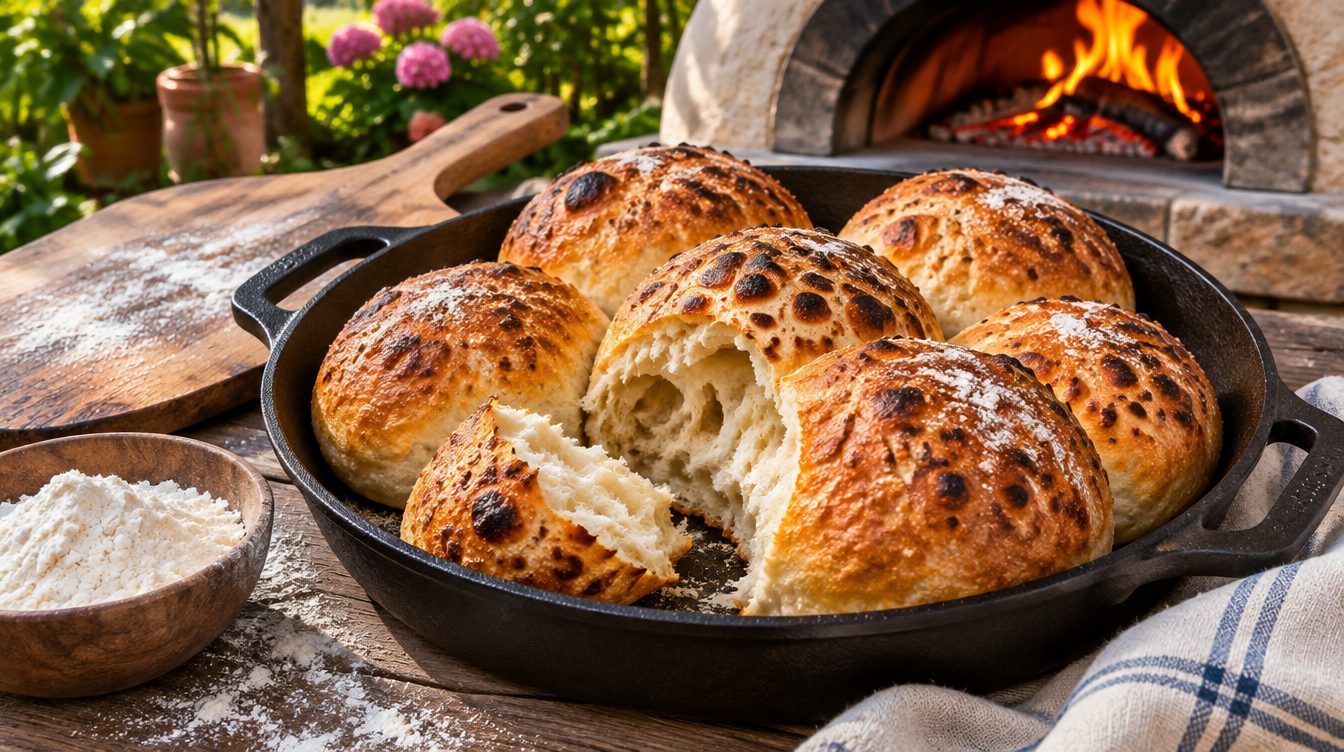
A pizza oven is a superb bread oven, as long as you treat it differently from a pizza session. Rolls baked in an outdoor oven get a crackly, blistered crust and a soft, open crumb that is hard to match in a kitchen oven. The secret is turning the heat down and keeping them moving.
Why bread needs a lower temperature than pizza
Pizza bakes in 60 to 90 seconds with the stone at 750°F (400°C) or more. A bread roll needs 12 minutes or longer for the inside to cook. At pizza temperatures the crust would burn long before the center was done. Aim for a stone temperature of 450°F to 500°F, with the gas on its lowest setting or a small wood fire that has burned down.
If you are new to managing temperature in your oven, our Ooni 101 guide covers the basics, and our guide to fixing an Ooni that will not stay lit helps if the low flame keeps going out.
Bake in a pan, not on the stone
Even at lower temperatures, a pizza stone stores a lot of heat and can scorch the bases of rolls. A cast iron pan or a small baking tray protects the bottoms and makes it easy to turn the rolls. Rolls baked close together also stay softer at the sides.
Recipe
Pizza Oven Bread Rolls
- Prep
- 25 min
- Cook
- 15 min
- Rest
- 1 hr 45 min
- Total
- 2 hr 25 min
- Makes
- 10 rolls
- Stone at 450°F to 500°F (230°C to 260°C)
- Lowest flame or a small fire
- Rolls done at 200°F to 210°F (93°C to 99°C) inside
Ingredients
- 500 g (4 cups) bread flour
- 325 ml (1 1/3 cups) warm water
- 7 g (2 1/4 tsp) instant yeast
- 10 g (1 3/4 tsp) fine salt
- 1 tbsp olive oil, plus extra for the bowl
- Semolina or flour, for dusting
Equipment
- Pizza oven
- Cast iron pan or small baking tray that fits the oven
- Pizza peel
- Infrared thermometer
Method
- Mix the flour, yeast and salt in a large bowl. Add the warm water and olive oil and mix to a shaggy dough.
- Knead for 8 to 10 minutes by hand, or 5 minutes in a stand mixer, until smooth and springy.
- Put the dough in an oiled bowl, cover and leave to rise for about 1 hour, until doubled.
- Divide into 10 pieces of about 80 g, shape into tight balls and place them in a cast iron pan or on a tray dusted with semolina, leaving a little space between them.
- Cover and proof for 30 to 45 minutes until puffy.
- Heat the pizza oven, then turn the gas to its lowest setting or let a wood fire die back, until the stone reads 450°F to 500°F (230°C to 260°C).
- Bake the rolls for 12 to 18 minutes, turning the pan every 3 to 4 minutes so they brown evenly.
- They are done when deep golden, hollow sounding when tapped, and 200°F to 210°F (93°C to 99°C) inside. Cool on a rack for 10 minutes before eating.
Notes
- Baking in a pan rather than directly on the stone stops the bases burning.
- The end of a pizza session is the perfect time to bake rolls, once the oven has started to cool.
Tips for better rolls
- Bake them at the end of a pizza session, once the oven has started to cool.
- Turn the pan every 3 to 4 minutes, because one side of the oven is always hotter.
- Brush the tops with milk or egg for a shinier, darker crust, or with olive oil and flaky salt.
- Use an instant read thermometer if you are unsure. Bread is done at 200°F to 210°F inside.
Frequently asked questions
Can you bake bread in an Ooni?
Yes. Use the lowest flame, bake in a pan, and turn the bread often. Small rolls and flatbreads are easier than large loaves.
Why are my pizza oven rolls burnt outside and raw inside?
The oven was too hot. Let the stone drop to around 450°F to 500°F and bake for longer.
Can I use pizza dough for rolls?
Yes. Pizza dough makes good rolls, although a dough with a little oil gives a softer crumb.