At a glance
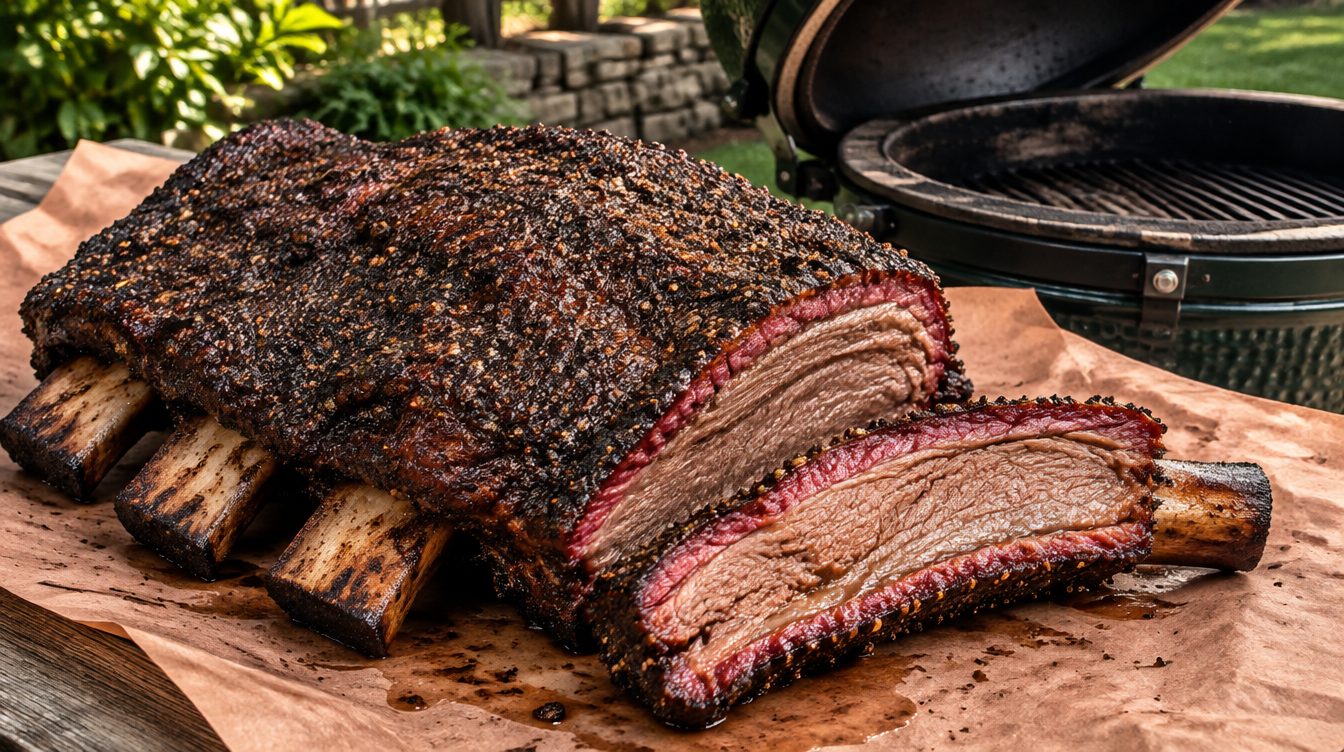
Season a rack of beef plate ribs with coarse salt and pepper and cook them indirect on a kamado at 265°F to 275°F with oak or hickory. Spritz them hourly after the first 3 hours, wrap them in butcher paper once the bark sets if you like, and cook them until they are probe tender at about 203°F to 205°F. That usually takes 8 to 10 hours. Rest them for an hour before slicing.
Beef plate ribs, sometimes called dino ribs, are the showpiece of Texas barbecue: huge bones carrying thick slabs of brisket like meat under a black pepper bark. A kamado grill is perfect for them. Its thick ceramic walls hold a rock steady temperature for hours on a single load of charcoal, and its moist cooking environment keeps the meat juicy through the long cook.
Plate ribs vs chuck ribs
Plate ribs come from the short plate, ribs 6 to 8, and are the biggest and meatiest beef ribs. Ask your butcher for a three bone plate rib, sometimes listed as IMPS 123A. Chuck short ribs come from ribs 2 to 5 and are a little smaller with slightly less meat, but they cook the same way. Avoid back ribs from the rib roast, which have very little meat on top.
Setting up the kamado for a long cook
Fill the firebox to the top with large lump charcoal, mixing in a few chunks of oak or hickory, and light it in just one spot so it burns slowly across the load. Fit the heat deflector and a drip pan. Bring the temperature up slowly, as a kamado is much easier to raise than to bring back down. Our guide on how to use a kamado grill covers vent control, and if you see thick white smoke, read why a kamado smokes too much.
Recipe
Kamado Beef Ribs
- Prep
- 20 min
- Cook
- 9 hr
- Rest
- 1 hr
- Total
- 10 hr 20 min
- Makes
- 4 to 6 servings
- Kamado at 265°F to 275°F (129°C to 135°C), indirect
- Optional wrap at about 170°F (77°C)
- Probe tender at about 203°F to 205°F (95°C to 96°C)
Ingredients
Ribs
- 1 rack beef plate ribs (3 bones), about 4 to 6 lb (1.8 to 2.7 kg)
- 1 tbsp yellow mustard or olive oil, as a binder (optional)
Rub
- 2 tbsp coarse black pepper (16 mesh if you can find it)
- 2 tbsp kosher salt
- 1 tsp garlic powder
Spritz
- 1/2 cup (120 ml) water
- 1/2 cup (120 ml) apple cider vinegar
Equipment
- Kamado grill with heat deflector
- Drip pan
- Large lump charcoal and 2 or 3 chunks of oak or hickory
- Butcher paper (optional)
- Probe thermometer
- Spray bottle
Method
- Trim off the thick membrane and any hard fat from the top of the rack, leaving a thin layer.
- Mix the rub. Apply the binder if using, then season the ribs heavily on all sides.
- Fill the kamado with lump charcoal, mixing in the wood chunks, and light it in one spot. Fit the heat deflector with a drip pan on top.
- Bring the kamado up slowly and stabilize it at 265°F to 275°F (129°C to 135°C), waiting for clean, thin smoke.
- Put the ribs on the grate bone side down, insert a probe between the bones and close the lid.
- Cook for about 5 to 6 hours, spritzing every hour after the first 3 hours, until the bark is dark and set and the meat is around 170°F (77°C).
- Wrap in butcher paper if the bark is where you want it, or continue unwrapped.
- Cook until the meat reaches about 203°F to 205°F (95°C to 96°C) and a probe slides in like soft butter between the bones, usually 8 to 10 hours in total.
- Rest the ribs, wrapped in a towel inside an empty cooler, for at least 1 hour. Slice between the bones to serve.
Notes
- A full firebox of large lump charcoal easily lasts 10 hours or more in a kamado. Do not open the lid more than you need to.
- Chuck short ribs (4 bones from the chuck) work the same way and are a little smaller and cheaper.
How to tell beef ribs are done
Temperature is a guide, but tenderness is the real test. When a probe slides into the meat between the bones with almost no resistance, they are done. This is usually somewhere between 200°F and 210°F. Rest them well, as the meat firms up and reabsorbs its juices.
Frequently asked questions
How long do beef ribs take on a kamado?
Usually 8 to 10 hours at 265°F to 275°F for a three bone rack of plate ribs, plus an hour of resting.
Should I wrap beef ribs?
It is optional. Wrapping in butcher paper speeds up the cook and keeps the bark from getting too dark. Unwrapped ribs have a crustier bark.
Will one load of charcoal last?
Yes. A full kamado firebox of good lump charcoal usually runs 10 to 12 hours at this temperature.